
Digital Scanning
Today’s activity aimed to reproduce a digitally scanned hand-drawn plot. Thanks to software like Paint and Microsoft Excel, the steps became pretty simple. The one I used (shown below), was from an article in the Canadian Journal of Research around the year 1939. I apologize for not being able to note down the title and the author.

Digitally scanned hand-drawn plot. This plot was from an article in the Canadian Journal of Research.
To be able to obtain physical values equivalent to the pixel values in the image, a “scaling factor” must first be computed. Consider the equation of a line:
y = mx + b
The values of y are the physical values for both axes in the graph, whereas the values of x are the corresponding pixel locations.
Using Paint, the pixel locations of the tick marks in each axis and also the origin were noted. These were important for the computation of the distances between tick marks. Then, the actual tick mark intervals (i.e. 50 for the x-axis and 100 for the y-axis) must be divided by the corresponding pixel intervals between them. The average value of these quotients would be the slope m for the line equation. From here, the values of b could be computed. The results are tabulated in the following tables.

- Tabulated values for x-axis and y-axis.
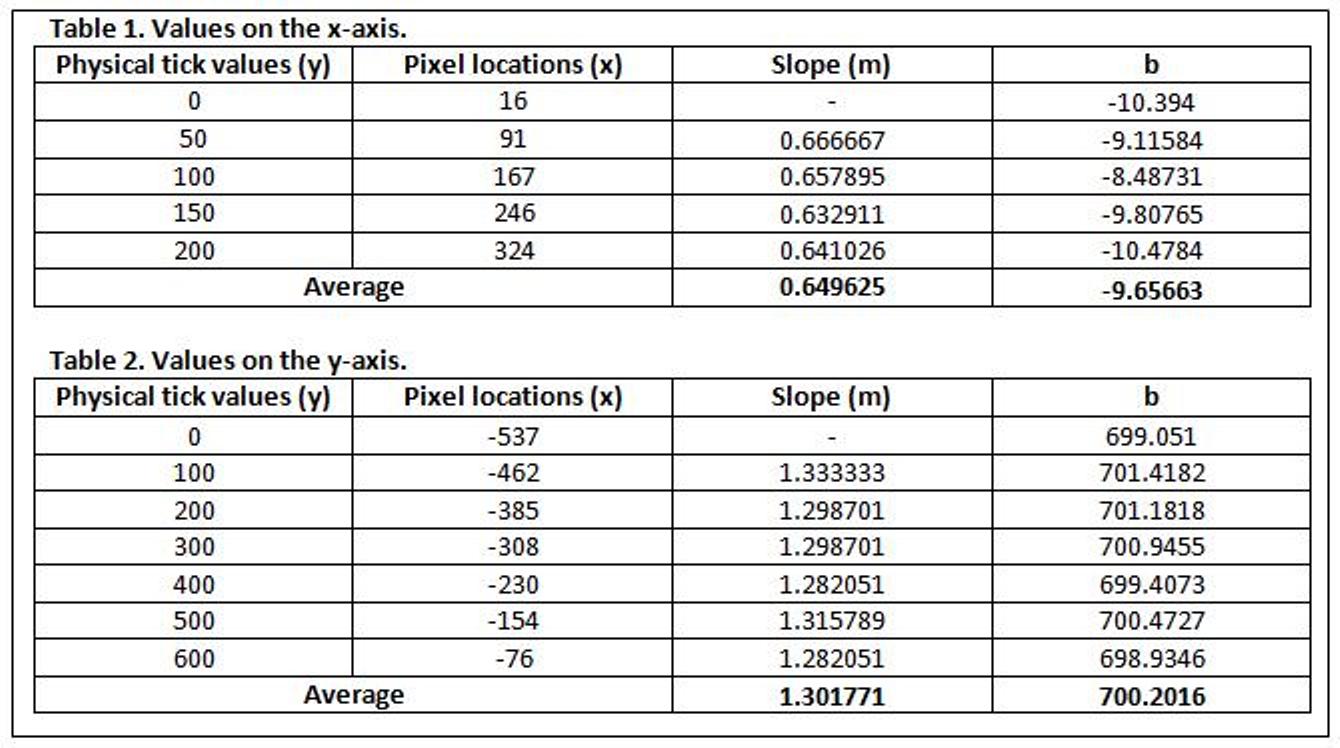
Next thing to do was to acquire more pixel locations (x) of the points in the plot. Using the m and b values above, the equivalent physical values (y) for x-axis and y-axis were then obtained. The following image shows the reconstructed graph superimposed on the actual graph.

- Superimposed scanned and reconstructed plots. The orange line shows the reconstructed plot overlapping the original scanned plot.

Self evaluation
I would like to give myself a score of 10 since I was able to reproduce the graph accurately. Furthermore, the images were clear and easily understandable.
 image processing